Organisations are weaving AI into the fabric of how they work, hoping to capitalise on the technology’s potential to unlock new value and transform their business. But a quiet anxiety is growing alongside the opportunity: “How do we know we can trust what our AI systems are doing - and how do we build that confidence at the pace we want to move?”
Getting this right requires more than a policy or adopting the most impressive technology. Sustained confidence comes from solid foundations: the right operating model. But many organisations are missing this fundamental step.
Taking an operating model approach to this problem will enable organisations to move with certainty, and to adapt successfully as technology, regulation and the competitive landscape continue to evolve.
The AI ‘trust gap’
As Agentic AI creates more autonomous systems, the ambition to act and reap the benefits pulls one way, while the confidence to account for behaviour often pulls in the other. These two forces create what is becoming known as the ‘AI trust gap’: the distance between what organisations want AI to deliver and what they can confidently stand behind.
In practice, the gap surfaces in uncomfortable ways. Regulators are asking tougher questions, customers want to know exactly how their data is used, and leaders are nervous about organisational readiness.
Potential scenarios include:
- If a regulator asked for evidence of how an AI system behaved six months ago, what could you provide?
- How do you know an AI agent has acted within its authorised boundaries - and who is accountable when it has not?
- When an AI agent takes an action in the world - calling an API, modifying a record, triggering a downstream process - are you confident that action is observable, auditable and recoverable?
- Do your people have the processes, skills and working practices to manage AI effectively - including the judgement to know when to challenge it, override it, or escalate?
- How well are you managing cyber risk? Can you withstand new attacks on the vulnerabilities that emerge when powerful tools are adopted faster than security controls can keep up?
Taking an operating model approach to closing the AI trust gap
When organisations think about creating trust in AI, the first instinct may be to produce a policy. This matters, but its only part of the picture. Ethics sits at the heart of trust too but no single framework, whether based on duties, outcomes or values, is enough on its own.
Organisations making real progress are developing their human infrastructure: the ability to navigate uncertainty, use judgement and adapt. The right conditions foster curiosity, sensible decision-making, and a genuine learning mindset, which help teams use AI responsibly, not just compliantly.
In most organisations, this work is already happening, with legal, risk, compliance, engineering and product teams all working on AI. But joining that work up requires getting the operating model right. In practice, this will mean creating clear accountability, implementing workable governance practices, and enabling decisions that ‘stick’.
Without that, the AI trust gap widens. Trust fades when ways of working don't make the right thing clear, consistent or observable.
Building trust as a connected set of AI capabilities
If we view the AI trust gap as an operating model problem, closing it means being deliberate about which capabilities need to be in place and how they connect.
Our AI capability map helps to visualise this across two layers: foundational capabilities for harnessing AI tools effectively, and transformational capabilities for driving long-term value. Trust runs through both but concentrates in a handful of areas.
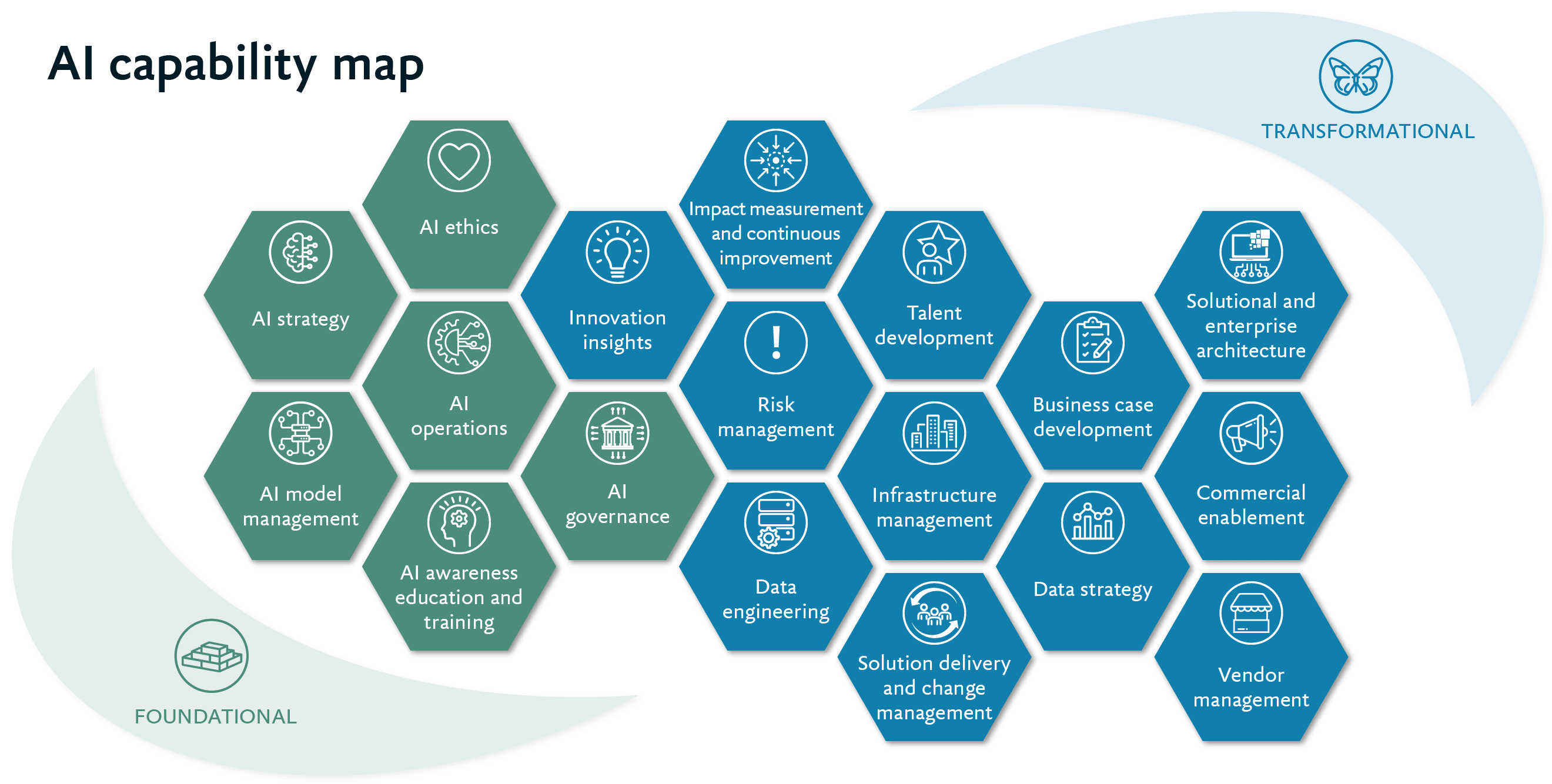
Part of this is technical. The AI operating system - the architecture, observability tooling, cyber controls and operational practices put in place - determines whether governance intent is enforceable in practice. It is what gives people the visibility to see what AI systems are doing, uncover problems early and intervene when something isn't right. As AI becomes more autonomous, this infrastructure matters more.
But the technical layer only takes you so far, and this is where many organisations are at risk of underinvesting. Many capabilities needed to close the AI trust gap are deeply human: ethics frameworks that set clear boundaries and guide judgement when lines are unclear; risk management disciplines that connect AI behaviour to the organisation's broader appetite for risk; governance structures that give policies real teeth; and the data practices that ensure models are built on trustworthy foundations.
Perhaps most underestimated of all is the talent and cultural conditions that allow people to use AI well, such as the capacity to know how AI actually works, good judgement, the ability to navigate ambiguity and real accountability for outcomes. These are not soft considerations sitting alongside the serious work. In most organisations, they could be the biggest drivers of the gap.
How to make progress on AI trust
Trust emerges when teams work together under a common direction, translating principles into coordinated action across people, process, information, structure and technology. Here is how organisations can start moving with intention.
Start with an honest picture.
- How mature are your foundational and transformational capabilities, specifically those that build trust the most?
- Which AI use cases are already in production?
- What controls exist - and are they technical or procedural?
Berkeley's AI Maturity Assessment
Recognising that many organisations are grappling with challenges at this stage, we have developed a real-time AI maturity assessment to help. Berkeley offers a complimentary half-day workshop, bespoke to your leadership team, to help shape your AI transformation - with trust at the centre.
Every organisation will draw the lines in slightly different places, shaped by their sector, risk appetite and the nature of the AI they are deploying. What matters is that those lines are drawn clearly, understood consistently and treated as a foundation, not a side consideration.
- If ten people across your organisation were asked to describe what trusted AI looks like here, would they give the same answer?
- Does your AI ethics position genuinely reflect your business risks - or does it default to generic principles that avoid hard decisions?
- Does your board understand it deeply enough to challenge where those lines are drawn?
Trust should not be a checkpoint at the end of a deployment. Instead, it needs to run through every stage. Past decisions should be reviewed and corrective action taken, while future work is designed with the right capabilities built in from the start.
- Are your governance teams involved at the start of AI projects, or brought in to review at the end?
- Are there systems already in production that have never been formally assessed against your current standards?
- Do your teams share a common understanding of where accountability sits?
There is no finish line in responsible and trusted AI, neither for those building these systems or those deploying them. Maintaining trust means keeping the definition current, revisiting assumptions as systems evolve, and ensuring the organisation's understanding stays sharp as technology and regulation continue to shift.
- When did you last revisit your AI governance framework in light of what your systems are doing today?
- Do you have a mechanism for identifying and addressing risks before they become incidents?
- As AI becomes more autonomous, are you confident your oversight is keeping pace?
Keeping pace with an extraordinary transformation
AI is moving fast - faster, in many respects, than any technology shift that has come before it. The organisations that will lead are not simply those deploying the most or moving the quickest. They are those investing in the understanding, the structures and the capabilities to do this well.
Trust is what makes that possible. It gives boards the confidence to back their AI strategies, gives customers and regulators reason to believe, and ultimately allows organisations to move with real ambition - because they have built the foundations to stand behind what they are doing.
This is an extraordinary moment. The organisations that treat trust not as a constraint but as a capability will be the ones that get the most from it.


Discover more

The author


Real-time maturity assessment workshop
Join Berkeley’s AI Transformation experts for a bespoke workshop with your AI teams. Our real-time review will show where you are on your journey, assess strategy and readiness, and outline clear next steps to maximise your AI investments.

AI operating model health check
Use our quick and easy online health check to assess the extent to which the required capabilities are in place in your business and geared up to deliver value.