Artificial intelligence (AI) is reshaping the nature of work at a pace few anticipated. Organizations across sectors are reconsidering not only how tasks are completed, but how roles are defined, how teams collaborate, and what skills will underpin future success. Yet amidst rapid technological advancement, the real shift underway is profoundly human: a move towards adaptability, curiosity, interdisciplinary thinking and continuous learning.
During Berkeley’s panel discussion event, AI: beyond the pilot, senior AI and digital leaders offered a shared perspective: the future workforce must be equipped for constant evolution, not one-off transformation.
Use AI to augment human strengths, not replace them
A key insight shared by the panel was that organizations must articulate clearly what humans do best. One of the panelists, a senior AI strategy leader at a global marketing services group, explained: “Most of the anxiety comes from people worrying their jobs are going to be replaced by AI. But if you have a clear answer as an organization – what do people do best, the human differentiator – you reduce that anxiety.”
Fear of displacement erodes engagement and slows adoption; leaders must understand this change management principle to roll out AI successfully. Leaders should focus on early and frequent communication, reiterating that AI’s role is to amplify, not diminish, human capability.
The ‘EQ’ aspect of any job, particularly relationship management and interpersonal problem-solving, will be difficult for AI to replace (at least, in the short term). Therefore, an important aspect of future skills training should focus on equipping leaders and employees to navigate the unique challenges posed by people.
As AI increases ambiguity and uncertainty in the workplace, organizations are likely to encounter a degree of negative reaction and resistance. Leaders need the skills to work successfully with reluctant and hesitant individuals and teams, to bring them on board with change and to deliver the right outcomes. The senior AI strategy leader highlighted behavioral traits such as “curiosity, intellectual humility, the ability to pivot and empathy – not just feeling with someone, but taking their perspective.”
Other examples from the panel illustrate the delineation between AI and human capacity:
- A global consumer products company’s brand teams are using AI to accelerate creative testing, not replace creativity
- Commercial teams are using scenario-based forecasting tools to enhance human decision-making
- Contact center agents are using AI assistants to answer informational inquiries more quickly, freeing up human agents to resolve complex problems and ultimately improving the customer experience.
In each case, AI handles labor intensive analysis while humans provide ingenuity and sound judgement.
Successful AI implementation requires integrated expertise
One of the most striking ideas shared by the senior AI strategy leader was the concept of the ‘M-shaped worker’. Such workers have expertise in multiple areas connected by integrated knowledge across disciplines. This contrasts with the T-shaped model (deep expertise in one area supported by broad capability across others) which has long shaped talent development.
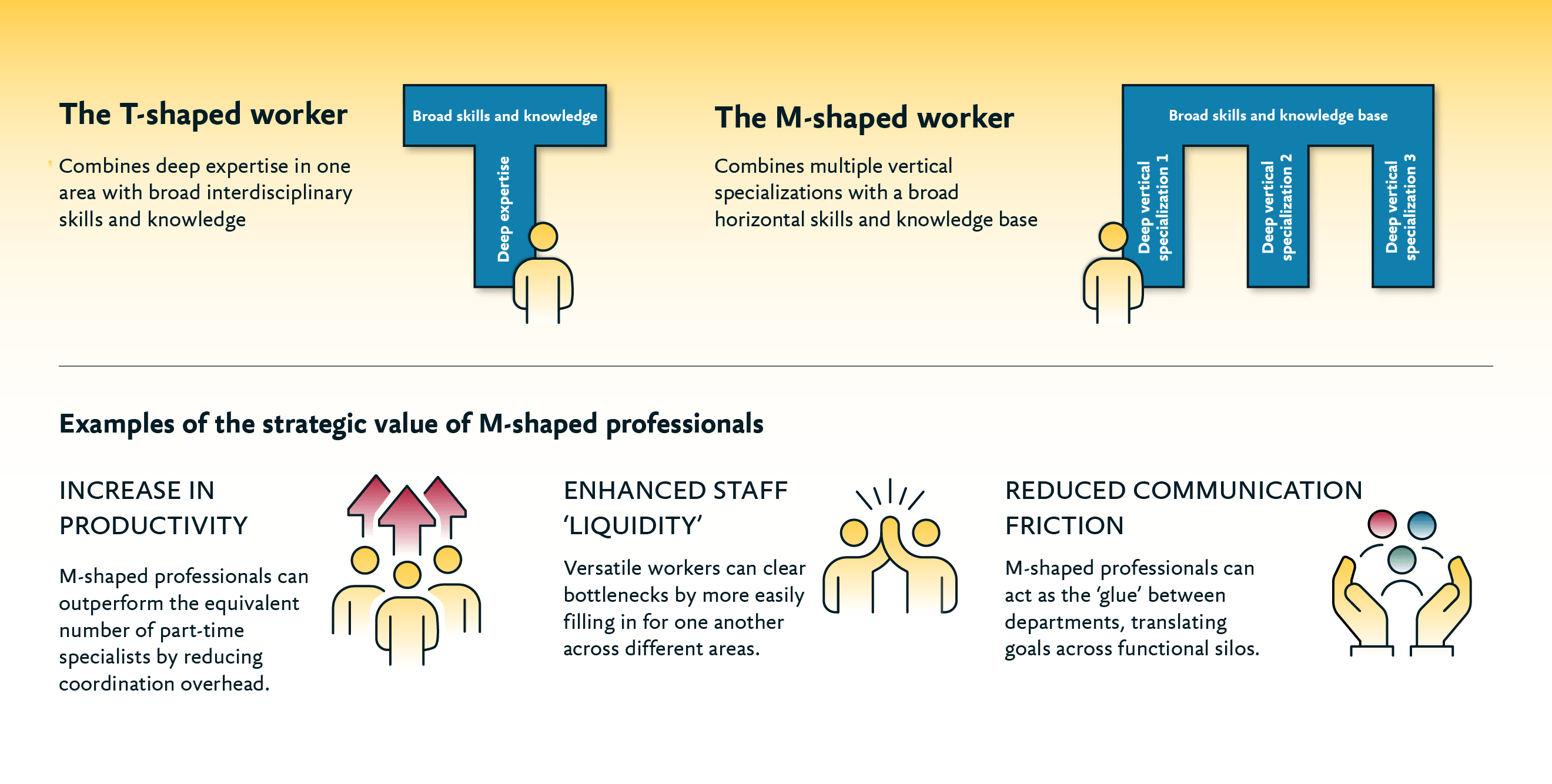
Embedding and exploiting AI on an enterprise-level scale requires multi-disciplinary collaboration, potentially dissolving the traditional boundaries between function. If problems are now cross functional, the people will need to be too. Forward-thinking organizations are cultivating M-shaped workers in anticipation of this major shift in work design.
Adopt continuous learning to achieve AI potential
Developing M-shaped workers will often require organizations to reimagine their approach to learning and development. The panel discussion highlighted the inadequacy of traditional training models in a world where AI tools evolve every few months. As one panelist observed, the introduction of tools like generative AI fundamentally changes the rhythm of work: “You don’t just learn it and roll out training, and then you’re done… every couple of months they’re going to have to learn some new stuff.”
This is different from how people have been adapting to change to date. Instead of being recipients of change, they will act as participants in change under this new training model.
Continuous learning is therefore no longer an optional employee benefit; it is the structural backbone of a future ready organization. Rather than annual programs delivered in classroom settings, organizations must embed learning directly into work design and provide the right support for employees to develop secondary specialisms.
The senior AI strategy leader suggested initiatives such as “role rotation programs” with a focus on stretching people in ways that will create value.
In the AI age, adaptability and curiosity matter
Ultimately, building adaptability within the workforce is becoming an important focus. In an environment where AI tools evolve faster than job descriptions can be rewritten, employees must be comfortable operating amidst ambiguity. This means:
- experimenting without fear of failure
- learning through rapid iteration
- questioning assumptions
- acknowledging when previous knowledge is outdated
Leaders, too, must adjust. As one panelist characterised it, leadership in an AI enabled environment requires “confident humility… to admit you may not know the answer upfront, but you know how to get the team there”.
This is not the dictatorial leadership model of the past, but a collaborative, curiosity-driven approach that encourages experimentation.
Human capability is the future differentiator
Successful organizations will be defined by those who can best learn, adapt and collaborate in ways AI cannot replicate. Organizations must build cultures that nurture the ‘M shaped’ employee: versatile, curious, and above all, deeply human.
AI brings speed and efficiency but it’s the people that bring strategy, creativity, and empathy. Together, they form the workforce of the future.


Discover more

The author