You’ve successfully trialled an artificial intelligence (AI) pilot and have ambitions for full-scale implementation. What are your next steps? The journey to unlocking AI’s transformative potential can be complex and many organizations struggle to scale beyond their pilots. Success depends not just on investment, but on understanding where you are, your strategy, and your organizational readiness.
Our recommendation for organizations pursuing enterprise-wide adoption is to start with a rigorous AI maturity assessment.
Why assessing AI maturity matters
Embarking on any transformation project, particularly one that leverages a frontier technology, can require significant levels of investment. Organizations must take stock of their current position, evaluating existing strategies, capabilities, and readiness to ensure that resources are directed where they will have the greatest impact. Without this clarity, even the most promising initiatives risk stalling or failing to deliver value.
An AI maturity assessment provides a structured lens through which to view your organization’s strengths and weaknesses, and identify any gaps. It enables leaders to make informed decisions, prioritise investments, and build a roadmap that aligns with both business objectives and operational realities.
Key steps for assessing AI maturity
Berkeley has guided a number of organizations through this comprehensive evaluation process. Applicable across every industry and organization-type, here are the essential steps.
1. Review your current AI operating model
Your ability to realise the full potential of AI investment is built around six foundational capabilities: strategy; ethics; model development; operations; governance; and awareness, education and training.
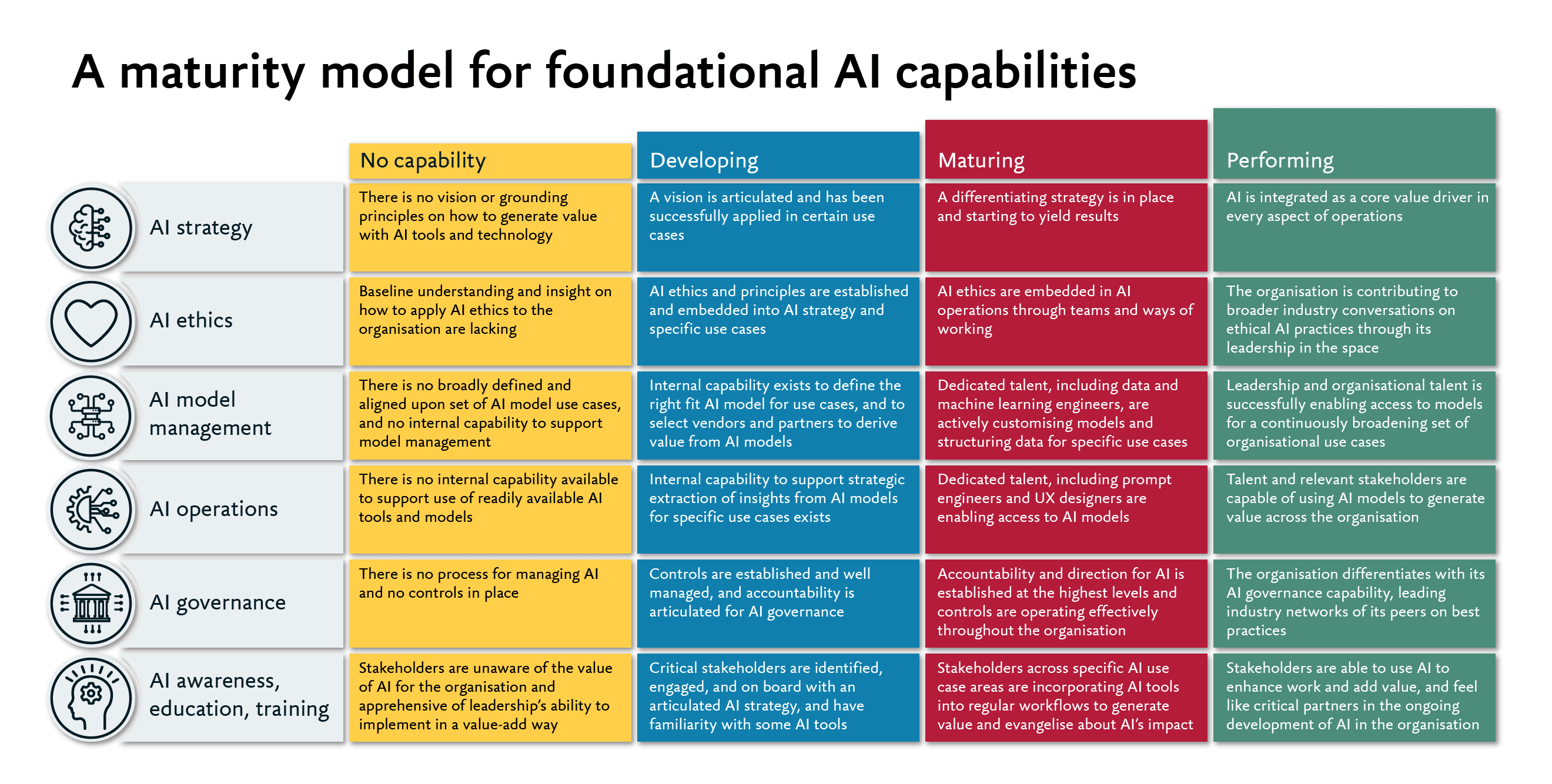
Assessing the current state of these capabilities within your organization will help identify focus areas for improvement and set the stage for deeper capability mapping.
Our self-service online health check can give a quick view of which capabilities are in place in your business and where there’s room for improvement.
2. Map current AI strategies and programmes
It’s essential to review existing AI-related strategies and programs. Whether your organization has commissioned studies, launched pilots, or delivered capabilities, these efforts should be mapped against the capability model. This step ensures alignment between strategic intent and operational execution.
It can also help you uncover internal perspectives on the success (or failure) of AI initiatives implemented to date. This is vital insight to guide stakeholder engagement and change management needs in the future.
3. Benchmark AI against competitors and peers
No organization operates in a vacuum. Benchmarking against other organizations within your sector or that are similar in another way (e.g. sector, scale, customer base, region etc.) provides valuable insights into industry AI trends, investment patterns, use cases and existing outcomes.
Gathering this information helps your organization determine where it stands and identify lessons that can be learned from others.
4. Agree AI focus areas and deprioritisation
With a clear view of current capabilities, in-flight initiatives and benchmarking data, the next step is to agree on your priorities. Capabilities that will enable key initiatives should be prioritised, but this means you need to consciously deprioritize other initiatives to maintain strategic focus. It’s crucial that key teams reach a consensus, ensuring that resources are allocated effectively.
5. Assess your AI gaps
A thorough gap assessment examines what’s needed to unlock the next level of maturity in each AI focus area. This should be a collaborative process, involving brainstorming to identify capability requirements, prioritising ideas, and assigning ownership.
6. Develop a roadmap
Bringing together the findings from the previous steps should allow you to construct a tangible roadmap, complete with actions, owners and target completion dates.
Consultancy help with your AI maturity assessment
There are clear steps for conducting an AI maturity assessment but that doesn’t necessarily mean an organization will find the process easy. Clients have frequently reached out to Berkeley for AI consultant support to undertake the required activities and ensure the assessment is thorough and delivers actionable results.
To help organizations in this position, we can offer a complimentary half-day workshop, bespoke to your leadership team, to achieve a real-time review, build consensus and develop a plan for action.
Our goal is to support organizations succeed in realising the full potential of AI, moving beyond their pilots and achieving enterprise-level scale. By taking the right steps, organizations can successfully navigate the complexity, breaking down their AI transformation journey into tangible actions and ultimately generating true business value.



Related services

The author